
Physiotherapist Specialized in Tinnitus
Tinnitus is the perception of a sound in the absence of an external source producing it. The sound may have very different characteristics, and in 95% of cases, physiotherapy specialized in tinnitus can improve it.

Possible causes of tinnitus
There is no single direct cause for the onset of tinnitus, but several events have been identified that predispose a person to developing it:
Prolonged or intense acute stress
Cervical muscle contracture and/or neck tension
Jaw tension or temporomandibular joint (TMJ) dysfunction
Headache or migraine
Whiplash injury, traffic accidents, or similar trauma
Continuous or intense exposure to noise
How do we help you?
First, we help you understand tinnitus, what makes it worse, what reduces it, and why. We perform an assessment of the cervical spine and jaw and propose the treatment to follow.
Evidence-based information about tinnitus
Cervical physical assessment
Jaw assessment
Exercise treatment plan
Tools for tinnitus management
Tinnitus treatment
The treatment plan is based on the functional assessment. Manual therapy techniques will be combined with exercise, and distraction strategies will be provided.
Manual therapy for the cervical region
Manual therapy for the jaw
Cervical and jaw training
High-intensity aerobic exercise
Distraction tools and techniques
Other recommendations (certain foods, advice on sound exposure, etc.)
Book your appointment
Tinnitus can be extremely distressing. We will not eliminate your tinnitus in a single session, but we will establish all the foundations of treatment so that you can take control and get rid of it.
First Visit (Assessment + Treatment) = 60 minutes
Follow-up Session = 60 minutes
Book an Appointment
The first question people ask when they are told that tinnitus is the perception of a sound in the absence of an external source producing it is: So where does this sound come from? What causes it?

The answer is simple, although it raises new questions that are much more difficult to answer.
To date, what we know is that there is a network of neurons that, in a resting state, has greater activity in people who experience tinnitus than in those who do not. This means that when the activity level of this neuronal network exceeds a certain threshold, tinnitus appears.
The opposite may also happen: the threshold may decrease, causing a normal level of activity in this neuronal network to be perceived as tinnitus.
This neuronal network is composed of two networks. One is related to emotional distress, and the other is known as the auditory memory and awareness network. This will become important and is explained further below.
To better understand it, we will use the metaphor of a fire and a wildfire.
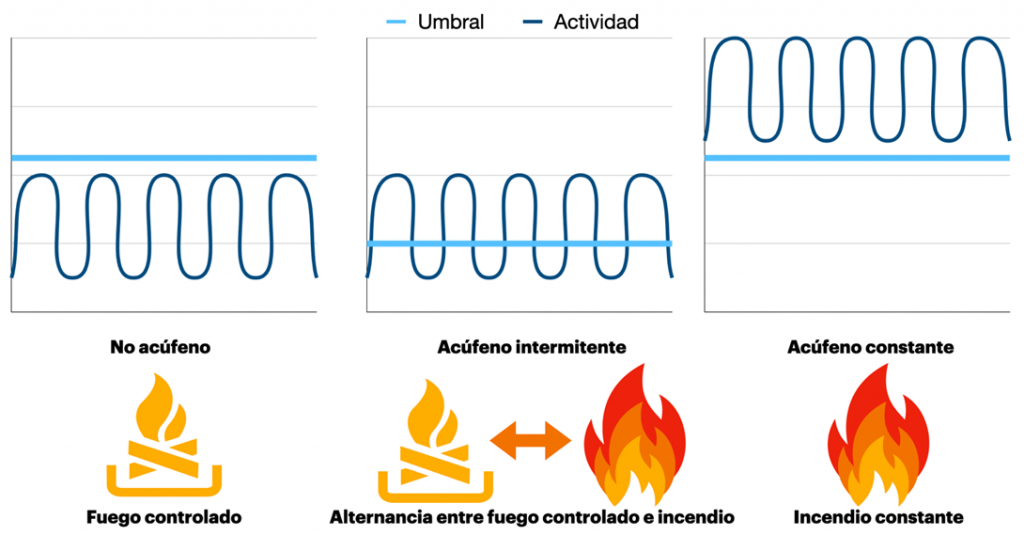
In a resting state, the normal activity of neurons would be like a small campfire, controlled within a stone fireplace. But if we feed the fire too much, it could start a wildfire and burn beyond the fireplace. This would represent increased neuronal activity, in other words, the appearance of tinnitus.
The following diagram illustrates neuronal activity (dark blue), which fluctuates over time. On the other hand, the threshold that determines whether tinnitus appears or not is represented by the blue line. We can see three situations: activity below the threshold (no tinnitus = controlled fire), activity fluctuating above and below the threshold (intermittent tinnitus = sometimes controlled fire, sometimes wildfire), and activity above the threshold (constant tinnitus = constant wildfire). The further above the threshold, the greater the intensity of the tinnitus.
The next question people ask is: What caused this wildfire (tinnitus)? This is difficult to answer because there is no single explanation. For some people it is acoustic trauma, meaning exposure to high levels of noise. Others report that it appeared during a very stressful period of their lives. Others developed it after a traffic accident (whiplash injury), after a dental procedure, or following an illness (for example, COVID-19). All of these causes represent stress on the body. Regardless of the type of stress, they all fall under the umbrella of stress.
Stress increases the activity of many areas of the brain, including the auditory memory and awareness network and the emotional distress networks, meaning it increases activity in the areas related to tinnitus. However, suffering from stress should not be considered the only cause, since many people experience stress without developing tinnitus. The reasons why this happens remain unknown, and research is currently addressing these questions.
Other related factors include alterations of the cervical spine and the jaw. It is known that jaw or neck tension, pain, or dysfunction in these regions increases the likelihood of developing tinnitus. The most widely accepted explanation is that increased activity in brain areas related to the jaw and cervical spine also increases the activity of the neuronal networks associated with tinnitus. In other words, continuing with the analogy, stress, the jaw, and the cervical spine are the fuel that feeds the fire—the firewood.
These three factors can improve through a specialized physiotherapy program and high-intensity aerobic exercise. In our analogy, this would be equivalent to throwing water on the fire to extinguish it.
There is one determining factor in achieving greater success in treating tinnitus, and most people who have suffered from it for a long time have experienced it firsthand. This factor is attention to tinnitus. Remember that tinnitus involves an auditory memory and awareness network. Therefore, paying attention to tinnitus increases awareness of it and helps reinforce it in our memory, just as hearing the voice of a family member or friend many times allows us to recognize that person simply by hearing their voice. The power of attention should not be underestimated. In our analogy, attention is the wind. The more attention, the stronger the wind, and consequently, the harder it is to extinguish the wildfire—that is, the tinnitus.
To reduce attention to tinnitus, distraction is essential. This is why tools and strategies are necessary to shift the focus away from tinnitus. Fortunately, the brain has a limited capacity for attention. If four people speak to you at the same time, you will not truly listen to any of them. But if you focus on one of them, you stop listening to what the other three are saying. In other words, if we want to take attention away from tinnitus, attention must be redirected to another activity that requires so much focus that the brain cannot simultaneously pay attention to the tinnitus.
The distraction factor is a key element because, if we manage to eliminate the wind, extinguishing the wildfire becomes possible.
Finally, and no less importantly, pharmacological treatment should be considered, since there are medications that can help reduce neuronal activity. The only drawback is that most medications have side effects, and some cannot be taken for extended periods. In cases of very severe tinnitus, pharmacological treatment should initially be considered while beginning physiotherapy treatment so that, when the medication is withdrawn, the rebound effect is minimized.
In any case, tinnitus can be eliminated; it is not necessarily permanent. Is the method described above infallible? Of course not. It works partially for some people, others become completely free of tinnitus, while for others it has no effect at all. Why these differences exist remains largely unknown. What we do know is that we apply the best treatment currently available for tinnitus.
