
Specialized Physiotherapy for Dizziness and Balance Disorders
Dizziness and balance disorders are common symptoms that can appear for many different reasons. Specialized physiotherapy for dizziness and balance disorders identifies and treats the underlying cause of these symptoms, providing the most effective treatment currently available.

Possible Causes of Dizziness
There are many possible causes of dizziness and balance disorders. Below are the most important:
Whiplash injury
Cervical muscle contracture and/or neck tension
As a consequence of a previous episode of vertigo
Associated with headache or migraine
Following a traumatic brain injury
How do we help you?
We take a detailed history of your dizziness, identify the underlying causes and assess the body regions involved, such as the cervical spine. We perform a comprehensive evaluation of your balance capacity to develop a personalized exercise program.
Identify the type of dizziness, its origin and causes
Cervical physical assessment
Posture and balance assessment
Specific treatment
Dizziness Treatment
The treatment plan is based on the functional assessment. Manual techniques and exercises are used to restore lost abilities.
Manual therapy for the cervical region
Cervical proprioception exercises
Balance and postural control exercises
Eye–hand–neck coordination exercises
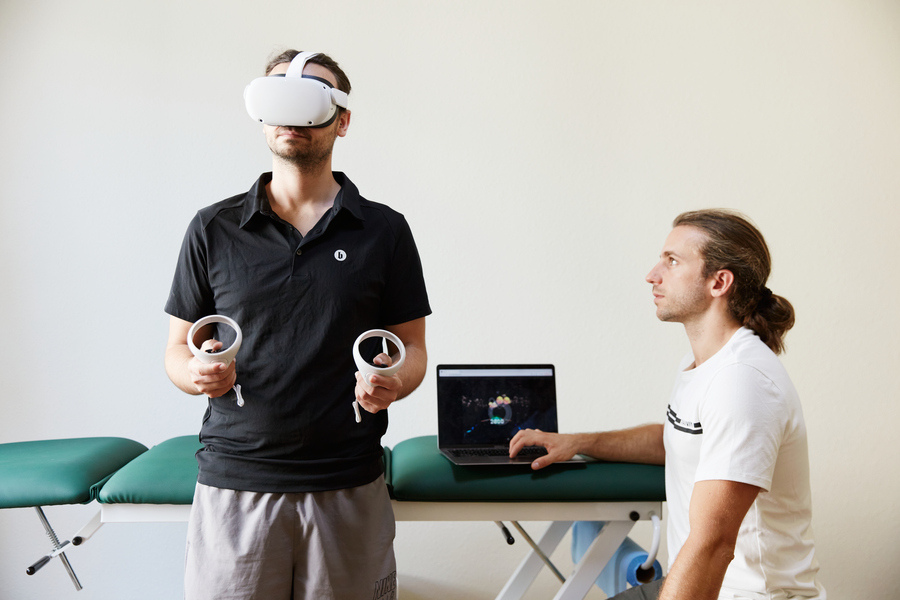
Virtual reality exercise
Other recommendations (aerobic exercise, ergonomics, home exercises, etc.)
Book your appointment
If you suffer from dizziness or balance disorders, you deserve a specialized physiotherapy assessment and treatment tailored to your condition. It usually takes only a few sessions to implement a complete treatment program that you can continue on your own.
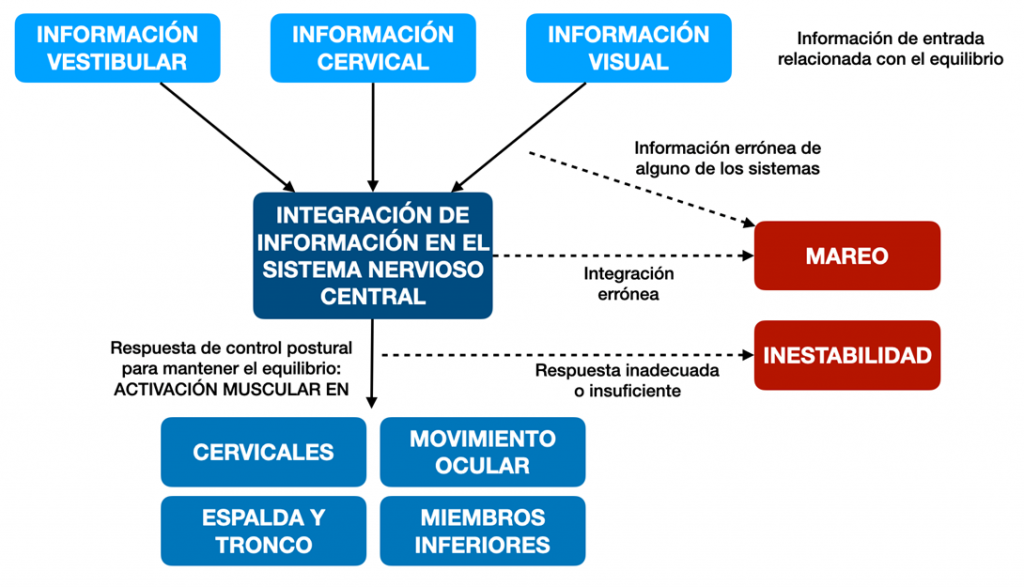
Postural control and balance are closely linked to head position, visual information from the eyes and information from the vestibular system. The brain integrates all of this information into what we call the balance neuromatrix, which activates the different body systems responsible for maintaining postural control and balance.
When we are standing still, balance is maintained through small adjustments in the activity of the muscles of the legs and trunk. In other words, balance is achieved through postural control. This process is constantly active, with the brain continuously evaluating visual, vestibular and cervical information to adjust postural control.
When one of these systems does not function properly, the integration of information becomes inconsistent, leading to errors in interpretation—that is, dizziness. As a result, inappropriate postural adjustments occur, causing a sensation of instability or even loss of balance.
This explains why disorders of the cervical spine can cause dizziness, a condition known as cervicogenic dizziness.
During the assessment, we evaluate how the brain integrates cervical, vestibular and visual information to determine which system is providing inaccurate input. At the same time, we assess the body’s balance response to this information by testing postural control under different conditions.
Treatment consists of exercises designed to improve the function of the system that is impaired and progressively enhance the coordination between visual, vestibular and cervical information, allowing the body to generate an appropriate response—in other words, to restore balance.
In summary, dizziness occurs when the sensory information from the eyes, vestibular system and cervical spine does not match, while instability or loss of balance occurs when the body cannot generate an adequate response to that information.
For this reason, dizziness and instability may occur together, dizziness may occur on its own, or instability may occur without dizziness.
The following diagram illustrates how the body integrates information from different systems to maintain balance, as well as the consequences of incorrect sensory integration (dizziness) or an inadequate motor response (instability).
Incorrect sensory integration may occur either because the information from the different systems is inconsistent, or because the information is correct but too difficult for the brain to process. The latter explains why people become dizzy when riding a roller coaster or spinning rapidly several times.
The balance system has a remarkable ability to adapt. A clear example can be seen in sports and the performing arts. Without this capacity for adaptation, humans would not be able to spin while dancing without becoming dizzy or drive a racing car. Developing this adaptation requires a well-planned training program and gradual, repeated exposure to stimuli that challenge the balance system.
During physiotherapy, we assess whether the different sensory systems involved in balance are functioning correctly. If one of them has lost capacity, we prescribe treatment to improve its performance, which will have a positive effect on dizziness. If the sensory systems are functioning properly but the body’s response is not optimal, treatment focuses on improving the response systems by enhancing postural control and balance.
