
Specialized Physiotherapy for Neck, Lower Back and Back Pain
Back pain is the most common cause of pain in our society. Most of the time, it is a type of pain that disappears within a few days and does not return. Other times, we experience recurrent episodes of back pain, and in some cases it persists over time, which is known as chronic pain. In 85–90% of cases, physiotherapy treatment is sufficient to eliminate back pain. In 10–15% of cases, it should be complemented with pharmacological or surgical treatment. Finally, in 1% of cases, physiotherapy cannot initially provide any benefit.

Symptoms
Back pain can occur anywhere along the spine and may even radiate into the upper or lower limbs.
Neck pain and lower back pain
Neuropathic pain or radicular syndrome
Disc herniation or disc protrusion
Stiffness and tension in the back and neck
Muscle contractures
How do we help you?
We assess the affected area both globally and specifically, gaining an in-depth understanding of your particular case and proposing a treatment plan tailored to you that is also easy to follow.
Clinical interview and in-depth understanding of your case
Assessment of the affected region, both globally and specifically
Diagnosis and pain assessment
Answering your questions
Specific and individualised treatment
Back Pain Treatment
The treatment plan aims to reduce, relieve and resolve your symptoms, provide you with strategies to manage them in the future, and prevent episodes of back pain from recurring.
Home exercises to relieve back pain
Exercises to prevent back pain
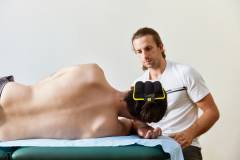
Manual therapy and massage for the spine and neck
Other recommendations (ergonomics, posture correction, etc.)
Book Your Appointment
Back pain requires a specialised approach based on knowledge and experience. If you experience back pain regularly, we recommend a treatment programme. If you are experiencing a one-off episode, a single session may be sufficient.
Most Common Diagnoses Associated with Back Pain
Neck Pain
Neck pain is one of the most common reasons for seeking treatment. Most of the time, neck pain is caused by the cervical joints or neck muscles, and other symptoms such as dizziness or instability may also occur. Physiotherapy resolves neck pain in the majority of cases.
Common Causes of Neck Pain
Neck pain may be caused by different factors. Depending on the underlying cause, the treatment will also differ.
Cervical muscle tension and muscle contractures
Neck stiffness and reduced mobility
Whiplash caused by traffic accidents, skiing accidents or other injuries
Disc herniations and protrusions
Compression of the cervical nerves
Symptoms Associated with the Cervical Spine
Cervical symptoms can vary greatly and are not always directly associated with the neck itself. A specialised physiotherapy assessment is required to determine whether these symptoms are related to the cervical spine.
Neck Pain
Headache or cervicogenic headache
Tingling or pins and needles in the arms and hands
Neuropathic pain in the upper limb
Dizziness and instability
How do we help you?
We carry out a comprehensive assessment and physical examination of the cervical spine to fully understand your condition. We assess strength, mobility and neck pain, establish a diagnosis, and develop an individualised physiotherapy treatment plan.
Clinical interview and case assessment
Assessment of strength, mobility and pain
Specific diagnosis
Individualised treatment
Answering your questions
Neck Pain Treatment
The cervical spine requires specialised physiotherapy treatment. A physiotherapist specialised in cervical disorders will manage your condition using different types of exercises, neck mobilisations and other treatment techniques tailored to your specific case.
Cervical and spinal mobilisations
Massage of the cervical muscles
Cervical muscle strengthening exercises
Self-treatment exercises and ergonomic advice
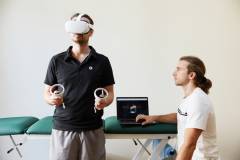
Virtual reality rehabilitation
Book an Appointment
The cervical spine requires a specific assessment and a specialised treatment approach due to its complexity.
A comprehensive treatment programme is recommended to resolve the pain and prevent it from recurring. If you also experience dizziness, instability, tingling or pins and needles in your arms or hands, or any other associated symptoms, a treatment programme is even more strongly recommended.
Neck pain is one of the most common conditions today. Its incidence has increased by more than 20% over the last 10 years and it is among the chronic pain conditions associated with the highest levels of disability throughout life. Furthermore, with the rise of remote working, these figures are expected to increase. After an episode of neck pain, between 50% and 85% of patients will experience recurrent pain in that region, especially if they do not receive specific treatment.
The factors involved in neck pain have been extensively studied. Certain prolonged working postures, or the use of the arms, especially during repetitive tasks, can lead to neck pain. Reduced movement in body regions such as the shoulders or the thoracic spine affects the load placed on the cervical spine, causing the cervical vertebrae and muscles to bear greater mechanical stress. Likewise, the strength and endurance of the muscles in the cervical region influence the ability of the neck to withstand mechanical loads and protect itself. In addition, the cervical spine has very important eye-neck and eye-hand coordination functions for most daily activities. When the cervical spine is affected, in addition to pain, it is also possible to experience muscle contractures, difficulty concentrating, blurred vision, dizziness, instability, or headache.
In most cases, neck pain does not have a clear cause, even though imaging tests such as X-rays or MRI scans may show certain signs of degeneration. These findings are common in most people without neck pain. The opposite is also true: patients with neck pain often show no signs of degeneration or inflammation of the cervical spine on imaging tests, meaning that imaging findings alone do not explain neck pain.
For this reason, neck pain requires a specialised physiotherapy diagnosis to determine the causes of the pain, which may include muscle contracture, muscle tension or stiffness, irritation of the cervical spine joints, or problems related to the cervical discs.
The physiotherapist will also assess cervical function, including strength and mobility, and will evaluate the level of disability caused by the neck pain, allowing improvements to be monitored objectively.
One of the most extensively studied causes of neck pain is pain or disorders associated with whiplash. Whiplash is the most common condition resulting from road traffic accidents and is also one of the leading causes of disability and sick leave today.
Whiplash is not exclusive to road traffic accidents. In many sports, trauma affecting the cervical spine may occur, such as skiing, mountain biking, martial arts, or contact team sports (football, basketball, rugby, etc.).
The signs and symptoms experienced after a whiplash injury are known as Whiplash-Associated Disorders (WAD) and are similar to those of non-traumatic neck pain, except that serious injuries resulting from the trauma must first be ruled out in the emergency department.
Serious injuries that must be ruled out include vertebral fractures, traumatic brain injury due to concussion, among others. The initial assessment classifies Whiplash-Associated Disorders into four grades.
Grade IV indicates the presence of a serious pathology confirmed by imaging tests.
Grade III involves injury or dysfunction of the nervous system. The assessment reveals reduced reflexes, sensory deficits, tingling, muscle cramps, or muscle weakness.
Grade II involves limitations in activities of daily living due to neck pain, without neurological signs or symptoms.
Grade I involves signs and symptoms such as pain, tenderness, or stiffness that do not interfere with activities of daily living.
The higher the grade of injury, the longer the treatment and the greater the number of recovery phases required.
Treatment for Grades IV and III may initially involve medication and surgery, in addition to imaging or other diagnostic tests during the initial and follow-up stages. In the later stages, physiotherapy treatment is fully indicated to restore the functions and capacities of the cervical spine, allowing patients to return to their normal daily activities.
For Grades I and II, imaging tests and other investigations are generally not recommended beyond the functional tests and physical examination performed during the physiotherapy assessment. Treatment focuses on improving symptoms such as neck pain, stiffness, instability, or dizziness, while increasing the function and capacity of the cervical spine, enabling the patient to perform all types of daily activities.
Treatment aims to eliminate pain and improve cervical spine function, thereby reducing the disability caused by the pain. Manual therapy techniques, cervical strength and endurance exercises, cervical motor control exercises, and eye-hand coordination exercises related to cervical spine function are used. To enhance these aspects, we use state-of-the-art tools such as virtual reality, which allows visual and manual coordination related to the cervical spine to be retrained safely, progressively, and in an enjoyable way.









Lower Back Pain
Lower back pain is the most prevalent type of back pain and the most common musculoskeletal pain complaint seen in primary care within our society. In general, episodes of lower back pain last from a few days to a few months. However, in around one-third of cases, the condition becomes recurrent, with these individuals experiencing episodes of lower back pain at least once a year. Physiotherapy is effective in the majority of lower back pain cases (>90%), particularly in chronic and recurrent lower back pain.
Types of Low Back Pain
Low back pain is classified into 3 groups, and this classification allows us to identify severe, moderate, and mild conditions.
85–90% Non-specific low back pain. It has a good prognosis with physiotherapy.
10–15% Low back pain involves nerve involvement and, in addition to physiotherapy, may require medication or surgery.
1% of low back pain cases correspond to a serious condition such as a tumour or a fracture. It requires early diagnosis and medical treatment.
Subgroups of low back pain:
Within the group of non-specific low back pain (85–90%) there are many different conditions that can be treated with physiotherapy alone, for example:
Muscular pain, muscle contractures, tension
Discogenic syndrome (disc involvement, herniated discs, disc protrusions)
Facet joint syndrome (involvement of the spinal joints)
Within the group involving nerve disorders (10–15%) we find:
Radicular syndrome, neuropathic pain (electric, stabbing, burning pain, etc.)
Spinal canal stenosis (tingling, loss of sensation and/or weakness in the legs)
Radiculopathy (tingling, loss of sensation and/or weakness in the legs)
How do we help you?
A good diagnosis leads to effective treatment. We identify the causes of your low back pain and the contributing factors in order to successfully manage your case.
Diagnosis of low back pain
Manual therapy, massage
Therapeutic exercise for low back pain
Strength training for the legs and lower back
Ergonomic advice and pain-relieving posture recommendations
Support when returning to your usual activities
Book an Appointment
An initial diagnosis of low back pain only takes one session. Establishing an effective long-term treatment plan requires the patient to learn specific exercises, which will be taught and reviewed weekly during appointments to correct, adjust, and progressively advance the programme.
Low back pain is the most common musculoskeletal pain complaint seen in primary care in today’s society, and the most common type of back pain.
Low back pain is pain located in the lower part of the back, from the last thoracic vertebra down to the sacrum and pelvis. It can be highly disabling, severely limiting participation in everyday activities.
In general, episodes of low back pain usually last from a few days to a few months. However, in a significant number of people—around one-third of all low back pain cases—it becomes recurrent, with episodes occurring at least once a year. In some cases, the pain does not resolve on its own after 3 months or even after a year unless specialised physiotherapy treatment for back pain is provided. Simply eliminating the pain is not enough to prevent it from returning; specific exercises are recommended to reduce the risk of recurrence.






The causes of low back pain can vary. The least common are serious conditions, which relate low back pain to spinal tumours, cauda equina syndrome, spondylolysis or spondylolisthesis, fractures, vascular diseases, rheumatic disorders, or referred visceral pain. All of these causes account for only around 1% of low back pain cases.
Secondly, around 5–10% of cases involve radicular syndromes, in which the nerves in the back are affected, specifically at the level of the dorsal nerve root or the dorsal root ganglion. Nerve irritation is mainly caused by a herniated disc or a disc protrusion, although other chemical factors can also irritate the nerves in the lumbar spine. This condition is commonly known as sciatica, although the term “sciatica” is often overused to describe many different types of low back pain and lumbar disorders.
The pain usually radiates down the leg and is described as electric, shooting, or burning in nature.
It may worsen when coughing or blowing your nose, is often more intense at night regardless of your position, and certain postures during the day may partially relieve the pain.
In these first two groups, magnetic resonance imaging (MRI) and other diagnostic tests provide valuable information, as does pharmacological treatment in the second group.
The third group, which accounts for around 90% of low back pain cases, may show small disc protrusions, herniations, or signs of joint degeneration on imaging. However, these findings are not associated with compression of the spinal canal or the neural foramina—in other words, they do not affect the nerves. In these cases, imaging provides very little useful information for treatment and, in fact, should generally not be performed, as it often creates unnecessary confusion. A specialised physiotherapy assessment is extremely valuable in identifying which structure is responsible for the pain, whether it is the muscles, the lumbar facet joints, the sacroiliac joint, or the intervertebral disc.
Physiotherapy is the first-line treatment in these cases. In the other two groups, physiotherapy also plays an important role, although for neuropathic pain, medication is generally recommended as the short-term first option, with physiotherapy beginning after the first 48–72 hours. Recovery from neuropathic low back pain generally occurs in two phases. The first is the acute phase, characterised by greater pain and disability, lasting approximately 3 weeks. The second, the subacute phase, may last between 3 and 6 months. It is estimated that 88% of patients achieve partial recovery after 6 months, while 65% recover completely within one year. Physiotherapy treatment aims to improve these outcomes and reduce the likelihood of future recurrences.
Cervicobrachialgia or Cervical Radicular Syndrome
Pain in the arm may be caused by a disorder affecting the cervical spine. When the nerves of the cervical spine become compressed or irritated, they can cause pain along their entire course. Electric, burning, spontaneous, sharp or stabbing pain is typically associated with cervical nerve compression, known as cervical radicular syndrome or cervicobrachialgia. It accounts for around 10% of cases of neck pain and can be treated with specialised physiotherapy.
Symptoms
The typical symptoms of cervicobrachialgia, cervical radicular syndrome and other conditions involving neuropathic pain include:
Electric, stabbing or burning pain occurring in bursts
Symptoms extending from the neck down to the hand
Constant pain with varying intensity or spontaneous pain
Pain that may worsen at night
Loss of sensation and muscle weakness
Tingling and pins and needles in the arm or hand
Associated Conditions
The most common causes of this type of neck pain are:
Cervical disc protrusions and herniated discs (most common)
Diabetic neuropathy
Cervical myelopathy
Parsonage-Turner syndrome
Others (neoplasms or infections)
These conditions are sometimes confused with peripheral neuropathies such as:
Carpal tunnel syndrome
Thoracic outlet syndrome
T4 syndrome
How do we help you?
We carry out a detailed interview to fully understand your condition and how it affects your daily life in order to establish the treatment priorities. We perform a thorough assessment of sensation, strength and reflexes, as well as evaluating multiple pain parameters and the condition of the cervical spine.
Comprehensive clinical interview
Nerve assessment
Pain assessment
Cervical spine examination (mobility and strength)
Personalised treatment plan
Treatment
Physiotherapy sessions aim to reduce pain and include exercises to improve cervical spine function and restore deficits in sensation and strength.
Mobilisations and massage
Strength training
Cervical stretching and mobility exercises
Spinal mobility exercises
Aerobic exercise adapted to the cervical spine
Ergonomic advice and recommendations
Book an Appointment
Every case of cervicobrachialgia is different in terms of treatment. However, physiotherapy is generally recommended during the first 2 to 3 months. Afterwards, once pain has improved and cervical function has recovered, follow-up sessions may be arranged if necessary.
The nerves that travel to the upper limbs emerge from the cervical spine, supplying the skin and muscles of the shoulder, arm, forearm and hand. Compression or irritation of these nerves within the cervical spine can lead to neuropathies and radicular syndromes such as cervicobrachialgia.
Pain may or may not be present in the neck itself and often radiates throughout the upper limb in different patterns. It typically has neuropathic characteristics such as burning, stinging or electric pain, and may be accompanied by signs of impaired nerve conduction, including muscle weakness in the hand, arm or shoulder, and reduced sensation in those same areas.
When there has been no trauma to explain injury to the nervous system, such as whiplash, there are several medical conditions that may cause these symptoms and should be properly diagnosed.
The most common conditions causing neuropathic neck pain include:
- Cervical myelopathy
- Neoplasms
- Infections
- Diabetes
- Parsonage-Turner syndrome
- Other degenerative diseases
There are also other conditions that can produce a similar pain distribution, such as thoracic outlet syndrome and T4 syndrome. In these cases, the nerve compression or irritation occurs either in the thoracic spine or in the space between the clavicle and the ribs. Here, the nerve is affected further along its course rather than at the nerve root.
Other disorders that may produce neuropathic pain or signs of impaired nerve conduction include entrapment neuropathies.
The best-known example is carpal tunnel syndrome, although others include ulnar neuropathy at the elbow and median nerve entrapment syndromes in the forearm.
Neuropathic pain originating from the cervical spine may affect the entire arm, causing cramping sensations, burning pain or electric shock-like sensations. It often appears spontaneously, tends to worsen at night, and may be influenced by certain neck or upper limb positions or movements that either relieve or aggravate the pain, although such positions are not always present.
In cases of peripheral nerve entrapment, neuropathic pain is not always present. Sometimes there is only well-localised stabbing pain accompanied by muscle weakness and reduced sensation.
Medical treatment often consists of injections of local anaesthetics such as lidocaine or corticosteroids, together with membrane-stabilising medications such as gabapentin or pregabalin. Injections are highly effective for short-term pain relief, but the underlying problem is not resolved without physiotherapy. Likewise, membrane-stabilising medications may take several days or even weeks to become effective, whereas physiotherapy generally provides the greatest short-term benefits.
From a physiotherapy perspective, neuropathic pain is managed using manual therapy together with specific exercises that gradually progress towards functional exercise. Aerobic exercise and ergonomic advice for work, sleep and other everyday activities may also be incorporated when appropriate.
