

What are jaw noises and clicking sounds, and why do they occur?
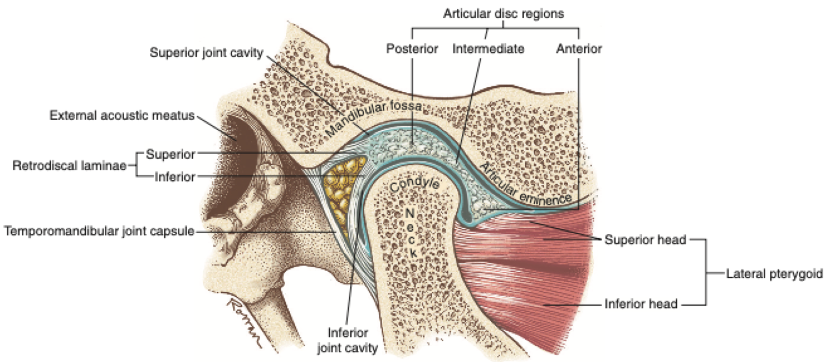
The temporomandibular joint (TMJ) is formed by the mandible (lower jaw) and the temporal bone. This joint consists of a joint capsule, ligaments, muscles, and an articular disc positioned between the two bones. Under normal conditions, this disc glides forwards and backwards, following the movement of the jaw during mouth opening and closing.
Figure 1. Anatomy of the mandibular region (Adapted from Neumann, 2017).
Like any other joint in the body, the TMJ can develop disorders that produce very characteristic signs and symptoms.
Figure 2. TMJ joint sounds and locking (Ohrbach et al., 2011).
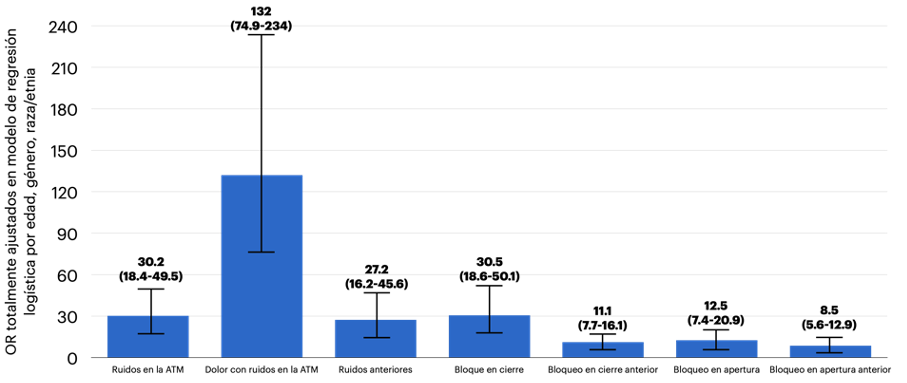
As shown, pain is frequently associated with joint noises. However, it is also possible to experience clicking or popping sounds without pain, as well as episodes of jaw locking during different stages of mouth opening.
These symptoms are commonly associated with conditions such as disc displacement with reduction (DDwR), disc displacement without reduction (DDwoR), TMJ osteoarthrosis, or TMJ osteoarthritis. Although these disorders occur predominantly in adults, they can also affect children and adolescents, as illustrated in Figure 3.
Figure 3. Prevalence of TMJ joint disorders according to age (Valesan et al., 2021).
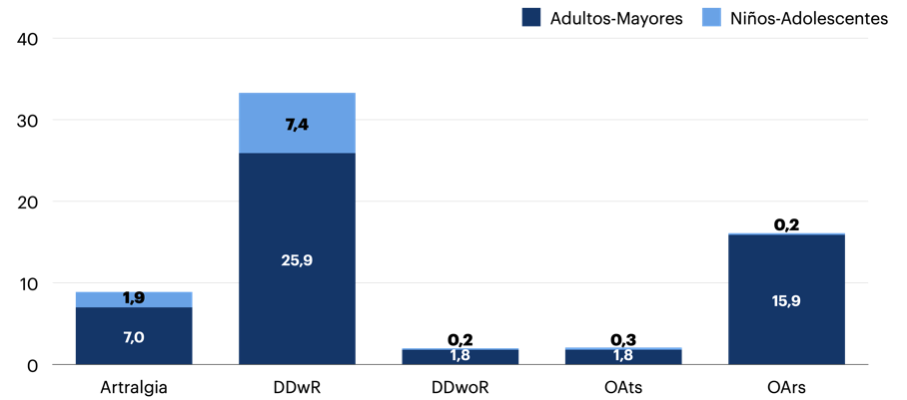
DDwR: Disc displacement with reduction; DDwoR: Disc displacement without reduction; OAts: Osteoarthritis; OArs: Osteoarthrosis.
What factors may contribute to TMJ clicking or locking?
Age:
The first factor, as previously mentioned, is age. TMJ disorders become more common as people get older. This is not surprising, since a longer lifespan naturally increases the likelihood of developing musculoskeletal conditions. Very few highly prevalent musculoskeletal disorders become less common with age.
Dental occlusion:
The way the upper and lower teeth fit together (occlusion) has traditionally been considered an important contributing factor. However, current scientific evidence shows that this belief is false. Numerous studies have demonstrated that there is no relationship between dental occlusion and the presence of TMJ clicking or locking (Gesch et al., 2005; Mohlin et al., 2007; Manfredini et al., 2017).
Bruxism:
Although the exact role of bruxism has yet to be fully established, there is evidence suggesting an association between increased tension or stiffness of the masticatory muscles and restricted mouth opening or jaw locking. However, research findings remain conflicting, with studies both supporting and refuting this hypothesis (Manfredini et al., 2010; Schogel et al., 2012; Jiménez-Silva et al., 2016).
Joint morphology:
Researchers have identified five different disc shapes and four different shapes of the temporal articular eminence (Figures 4 and 5).
Figure 4. Shapes of the articular disc (Serindere et al., 2021).
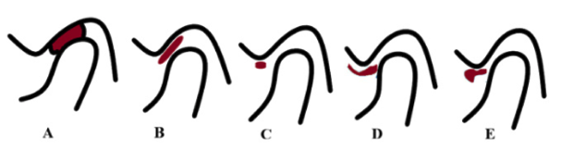
A) Biconcave; B) Biplanar; C) Biconvex; D) Hemiconvex; E) Folded
Figure 5. Shapes of the temporal eminence (Serindere et al., 2021).
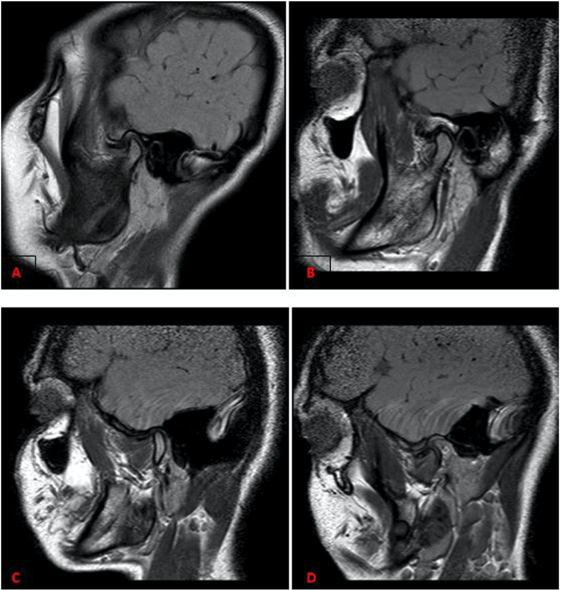
A) Box-shaped; B) Sigmoid; C) Flat; D) Deformed
None of the disc shapes were associated with a higher or lower prevalence of TMJ clicking or jaw locking. Among the temporal eminence shapes, only the flat (C) morphology showed an association with certain TMJ joint disorders.
Therefore, only one shape could be related to suffering from this pathology; later we will see what else we can comment on regarding the flattened shape.
Mastication: The way we chew can influence the development of TMJ disorders. In fact, people who habitually chew on one side—whether predominantly or consistently—are, on average, 4.5 times more likely to develop temporomandibular disorders (TMD), with the risk increasing to as much as 15.3 times in some cases (Santa-Mora et al., 2021).
DISCUSSION
The last two factors are of particular interest and play a major role. The development of the temporomandibular joint is closely linked to an individual’s growth during the early stages of life. At birth, the joint has a flat shape, allowing the jaw to move forwards and backwards, which is essential for feeding during infancy—in other words, it enables the sucking motion.
As weaning begins and more solid foods are introduced, the chewing movement develops. Mastication actually appears before the eruption of the primary (baby) teeth. In fact, chewing acts as a stimulus for tooth eruption and also shapes the articular surface of the mandible during growth, most of which occurs within the first 14 years of life. Early alterations in chewing patterns may reduce mechanical stimulation on the opposite side of the jaw, preventing the TMJ from developing normally. As a result, the joint may retain its flat morphology instead of evolving into one of the other shapes shown in Figure 5.
Several factors can contribute to the development of unilateral chewing during childhood, adolescence, and adulthood.
Missing teeth may limit balanced chewing, and the greater the number of missing teeth, the higher the likelihood of developing a unilateral chewing pattern. The key issue is not simply the absence of teeth, but whether their absence alters normal chewing function.
The same may occur in the presence of tooth pain or pain in one of the temporomandibular joints, leading the individual to avoid chewing on the painful side. The longer unilateral chewing persists, the greater the probability that one of the temporomandibular joints will develop structural pathology.
CONCLUSIONS
- The main factors associated with TMJ joint noises are related to structure and function.
- Joint structure is strongly influenced by function, particularly during the first years of life.
- Mastication appears to be the factor most closely associated with the development of jaw clicking and joint noises.
- Any factor that alters chewing ability—such as reduced strength of the masticatory muscles, a lack of hard foods in the diet, or tooth loss—may contribute to the development of TMJ disorders.
____________________
REFERENCES
– Neumann, Donald, A. KINESIOLOGY of the MUSCULOSKELETAL SYSTEM. Foundations for Rehabilitation. 2017. 3rd edition.
– Ohrbach R, Fillingim RB, Mulkey F, Gonzalez Y, Gordon S, Gremillion H, Lim PF, Ribeiro-Dasilva M, Greenspan JD, Knott C, Maixner W, Slade G. Clinical findings and pain symptoms as potential risk factors for chronic TMD: descriptive data and empirically identified domains from the OPPERA case-control study. J Pain. 2011 Nov;12(11 Suppl):T27-45.
– Valesan, L. F., Da-Cas, C. D., Réus, J. C., Denardin, A., Garanhani, R. R., Bonotto, D., Januzzi, E., & de Souza, B. (2021). Prevalence of temporomandibular joint disorders: a systematic review and meta-analysis. Clinical oral investigations, 25(2), 441–453.
– Serindere G, Aktuna Belgin C. MRI investigation of TMJ disc and articular eminence morphology in patients with disc displacement. J Stomatol Oral Maxillofac Surg. 2021 Feb;122(1):3-6.
– Santana-Mora, U., López-Cedrún, J., Suárez-Quintanilla, J., Varela-Centelles, P., Mora, M. J., Da Silva, J. L., Figueiredo-Costa, F., & Santana-Penín, U. (2021). Asymmetry of dental or joint anatomy or impaired chewing function contribute to chronic temporomandibular joint disorders. Annals of anatomy = Anatomischer Anzeiger : official organ of the Anatomische Gesellschaft, 238, 151793.
