

Why do we suffer from neck pain when working in an office?
Pain in the cervical spine is the second or third most common reason for consultation in primary care, depending on the context, after low back pain and shoulder pain. Its annual incidence is estimated to be between 10% and 20%.
We can divide neck pain into 4 grades according to the level of tissue involvement and its impact on daily life.
For Grades I and II, the level of disability determines management and prognosis, whereas for Grades III and IV, the severity of the condition is more relevant to prognosis.
In general, within the workplace, most cases of neck pain are Grade I or II. Occasionally, higher grades will not be related to the work environment unless they result from a traffic accident, a topic that will be covered in another post.
Grades of neck pain developed by the Neck Pain Task Force
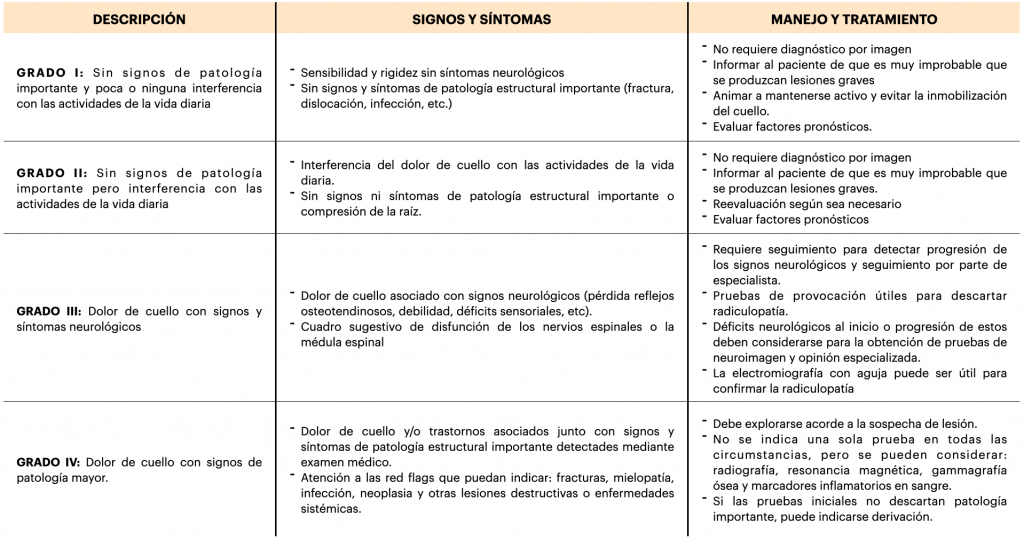
As we can see, for Grades I and II, imaging tests are not necessary. In fact, performing them would be a mistake, as they represent an unnecessary use of resources and would add no value to the diagnosis, while potentially causing unnecessary concern for patients.
This should be explained to the patient, as imaging findings can easily reveal abnormalities that have no diagnostic value.
It is, however, important to identify and assess the factors that contribute to an episode of neck pain.
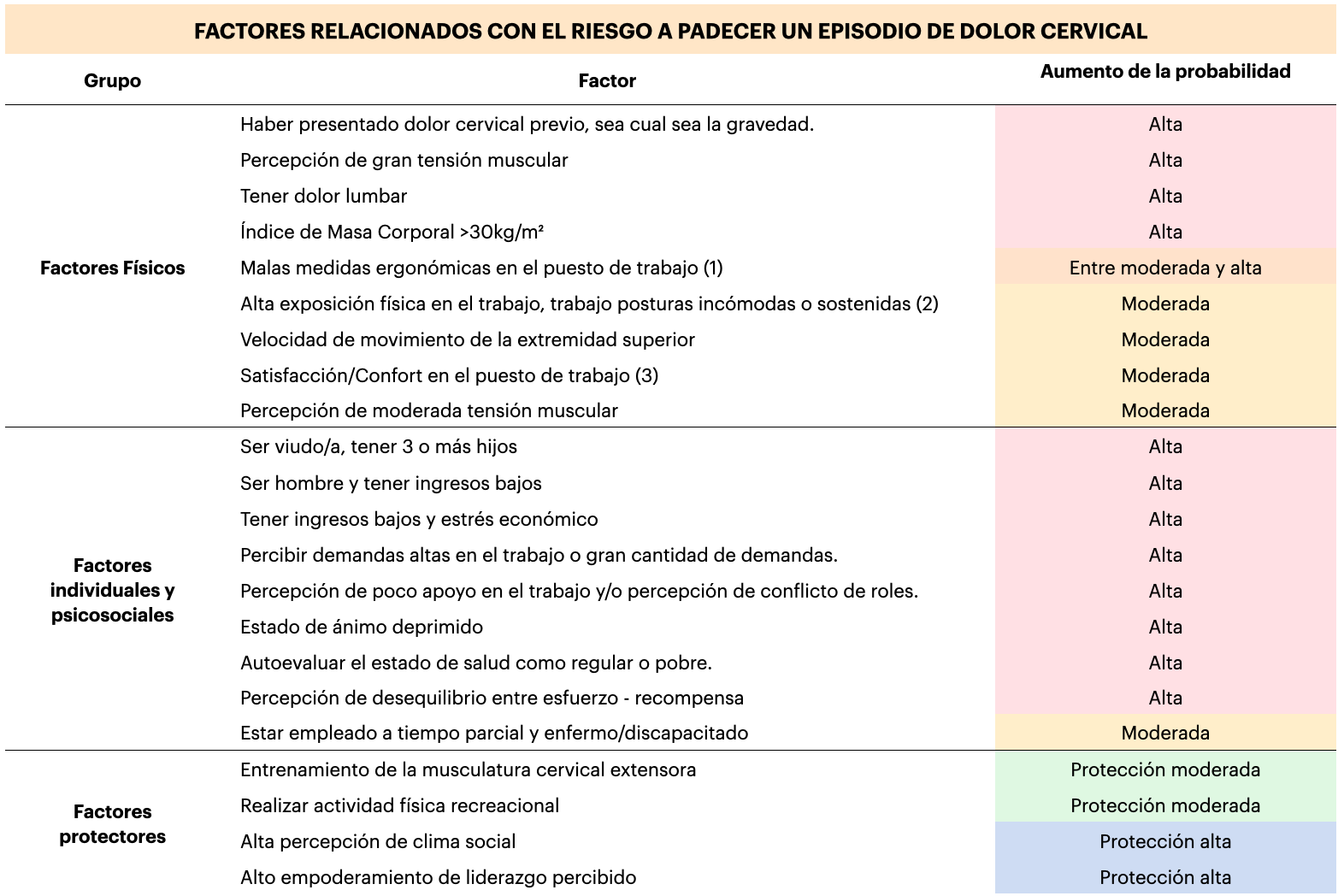
DISCUSSION
There are several aspects of these factors that should be clarified.
Most of these factors are related to perceived stress, as they contribute to creating a hostile environment. Stress activates biological processes that can be summarised by the “4 Fs”: fight, flight, fear, or fuck. The last term, fuck, refers to social support. In non-human primates, this translates into a greater number of sexual relationships with females or increased social grooming. In humans, our forms of social interaction are much broader, and social support can clearly act as either a protective or a risk factor in relation to perceived stress.
Ergonomic measures in the workplace (1) include the distance to the keyboard, mouse angle, screen glare, time spent using the keyboard, and time spent using the mouse. Recommendations suggest that using the keyboard for less than 4 hours per day and the mouse for no more than 3 hours per day would not play a significant role, whereas exceeding these thresholds may increase the risk exponentially. However, this issue is not entirely clear, and there are discrepancies regarding the recommended duration of computer work and the exposure level at which the risk of developing neck pain becomes significant.
On the other hand, perceiving work positions (2) as uncomfortable can play a role as a risk factor, regardless of the specific posture. What matters is how the individual evaluates it; that is, a posture is considered forced or not depending on our assessment of it. Of course, some postures have been labeled as better or worse than others due to popular belief. The belief system plays a fundamental role in how we evaluate a task.
Another aspect to consider at this point is exposure to high levels of physical exertion. The relationship between an individual’s capabilities and the physical demands of their work is directly linked to the likelihood of experiencing an episode of neck pain: a higher level of physical fitness would play a protective role.
Likewise, prolonged static postures are not advisable, as blood perfusion, and therefore the delivery of nutrients to tissues, decreases during prolonged sitting. Changing posture and performing aerobic exercise are practical strategies for improving vascularisation throughout the body.
Finally, the feeling of comfort or satisfaction in the workplace depends on the individual’s tolerance to different temperatures, noise levels, lighting conditions, and similar environmental factors. The more environments in which a person feels comfortable, the lower the likelihood of perceiving an environment as hostile and triggering a stress response. Individuals who regularly work in different environments are less likely to perceive a workplace as hostile than those who are highly focused on specific environmental conditions. The ability de adaptación sería un rasgo protector.
Conclusions: “Take home message”
For clinicians: Do not request neuroimaging for Grade I or II neck pain.
For patients: If we look at the different contributing factors, we can see that almost all of them are modifiable. From a physical perspective, increasing strength, improving general physical fitness, and enhancing adaptability (overall capacity) are ideal strategies for modifying these factors in our favour, and they can be trained throughout life. On the other hand, psychological factors relate more to how we evaluate and perceive different aspects of our environment and the level of hostility we attribute to it. Social factors are the most difficult to modify, as they do not depend solely on the individual, and we have limited ability to change the social labels placed upon us.
_______________________
REFERENCES
– Bier JD, Scholten-Peeters WGM, Staal JB, Pool J, van Tulder MW, Beekman E, Knoop J, Meerhoff G, Verhagen AP. Clinical Practice Guideline for Physical Therapy Assessment and Treatment in Patients With Nonspecific Neck Pain. Phys Ther. 2018 Mar 1;98(3):162-171.
– Guzman J, Haldeman S, Carroll LJ, Carragee EJ, Hurwitz EL, Peloso P, Nordin M, Cassidy JD, Holm LW, Côté P, van der Velde G, Hogg-Johnson S; Bone and Joint Decade 2000-2010 Task Force on Neck Pain and Its Associated Disorders. Clinical practice implications of the Bone and Joint Decade 2000-2010 Task Force on Neck Pain and Its Associated Disorders: from concepts and findings to recommendations. Spine (Phila Pa 1976). 2008 Feb 15;33(4 Suppl):S199-213.
– Jun D, Zoe M, Johnston V, O’Leary S. Physical risk factors for developing non-specific neck pain in office workers: a systematic review and meta-analysis. Int Arch Occup Environ Health. 2017 Jul;90(5):373-410.
– Shahidi B, Curran-Everett D, Maluf KS. Psychosocial, Physical, and Neurophysiological Risk Factors for Chronic Neck Pain: A Prospective Inception Cohort Study. J Pain. 2015 Dec;16(12):1288-1299.
